Tanking and cognitive bias

Song: "One Two Three (No Gravity)", by Closer Musik
I've been working on non-mathletix things, so I thought it would be a good time to revisit some previous topics.
Tanking in the NBA only works if a team's only problem is lack of a star player.
Otherwise, it's just a cop-out for being bad, and delays or prevents fixes to organizational problems.
Oceans of ink/pixels have been spilled about tanking, including on this very website. It's a classic example of perverse incentives and unintended consequences, and most of the fixes I've seen have their own set of issues. I worked on my own proposed solution -- basically, teams could declare themselves as rebuilding at the start of the year and have a chance at top draft picks in exchange for reducing ticket prices for fans, and receiving less in revenue sharing. My idea might fix some issues, but inevitably would create other ones. Any sufficiently complex game will have some sort of meta to it that has the potential for being exploited.
Tanking is bad (nebulously defined), but trying to fix it doesn't mean the league will become better off. It's very easy to create new issues. What would a perfect league look like? Only so many teams can be contenders at one time. What do the rest of them do, that isn't tanking, but is entertaining and interesting for fans?
As I previously talked about regarding the Kings, people point to the Thunder and Spurs as evidence that tanking works, as though it's some magic elevator to success. They both rapidly became top teams in the league after a few years of intentionally being bad. The Pistons and Rockets did, too. It's easy to draw the wrong conclusions from that.
But the Thunder and Spurs already had really good organizations before they decided to be bad. Handing talented players to organizations like the Kings, that suck at everything else, feels like a massive waste, especially when it's a multi-year tank job. Can we really trust the Wizards to develop Kyshawn George into the best version of himself?
As Keith Parrish pointed out recently on the Grits and Grinds podcast, tanking also hurts coach development and evaluation. There's no way to know if a coach is good or not if you are incentivizing them to be bad. How can a coach learn to run a playoff caliber team, or win in high-pressure situations, if the team isn't trying to be competitive at the end of games? Coaches need to develop, too.
I have some confidence the coaches of the Nets and Jazz are good, because their organizations seem to actively fight them in order to keep the tank rolling -- trading away good players, (apparently) mandating good players sit out the 4th quarter, players deciding season-ending surgeries for dubious injuries. Are they going to reach their potential as coaches, when they have to deal with all this nonsense?
The Toronto Raptors have turned the corner. Last year they were intentionally bad, and this year they're pretty good. They didn't end up with a good draft pick even after fairly shameless tanking efforts last year, though. The Jazz got fined this season for not playing their best players at all in the 4th quarter of a competitive game, but the Raptors invented that crap last season.
Was it worth losing a year of experience at being a competent basketball team in order to end up with the 9th pick instead of the 12th? That's hard to believe when the player they selected, Collin Murray-Boyles, isn't clearly better than Derik Queen (13th pick) or Cedric Coward (11th pick).
Front office staff don't count against the salary cap. It's amazing to me that some insanely rich owner like Steve Ballmer hasn't offered Sam Presti a $100M a year to GM their team. It would probably still be a value, compared to the GM the Clippers just extended, Lawrence Frank. (The GM who traded SGA and the farm for Paul George, not the "What's the Matter With Kansas" guy). Getting pantsed by Sam Presti in a trade should probably be the end of any NBA GM's career.
The favorite-longshot bias & the NBA draft
There's a favorite-longshot bias at work with the NBA lottery. Bets on longshots tend to be massively profitable for whoever is offering the bets, going back to horse races hundreds of years ago. This has continued with the rise of prediction markets, which are rife with longshot sucker bets, as this great analysis shows:
Contracts trading at 5 cents win only 4.18% of the time, implying mispricing of -16.36%. Conversely, contracts at 95 cents win 95.83% of the time. This pattern is consistent; all contracts priced below 20 cents underperform their odds, while those above 80 cents outperform.
I think people take longshot sucker bets because humans are bad at estimating small probabilities. People tend not to feel numbers in the same way every time. Context matters. 1 in 17 might seem like a good chance for a tanking NBA team to get the #1 pick, but a small chance of a negative outcome when somebody's considering a risky behavior.
The expected value of getting a top pick is also prone to bias. There's a decent probability of a top pick being a bust, and a non-top pick being a great player. Yet teams and fans treat a high draft pick as a sure thing, and middling picks as being worthless. Talent isn't fixed, though. A #15 pick in the hands of a competent organization could turn into a better player than a #3 pick for an incompetent organization.
If everyone in the NBA was healthy, my top players would be Jokic (drafted 41st overall), SGA (11th overall), Giannis (15th overall), and Wemby (1st overall). People say that the worst thing to be in the NBA is in the middle, but 3 of the top 4 players in the league right now could have been drafted there.
Who knows if they would have reached their full potential if they had been drafted by a bad organization. There are plenty of non-lottery players who can be coached up, and NBA teams need to be extremely deep now, something I think many organizations undervalue. A star player can make a big difference, but there need to be pieces around them, and tanking doesn't do anything to improve the chances of getting the other 12 guys, coaching them up, keeping them healthy, establishing an identity.
As previously discussed, four of the OKC Thunder's rotation players were undrafted or selected in the 2nd round. A team looking to emulate OKC's success could do almost everything that led to it without ever tanking.
Calculating the value of tanking requires multiplying two numbers together: the odds of getting a top pick, and the odds of that pick turning into a franchise-altering player. Multiplying two overestimates together will create an even bigger overestimate.
Stupid analytics, silly hiring process edition
The Cleveland Browns made waves this offseason for their approach to hiring a new head coach. This process required candidates to write an essay about why they wanted to coach the Browns, among other indignities.
This was billed by the team as being a data-driven, analytical approach to hiring -- as if the same franchise that decided to hire DeShaun Watson for the largest guaranteed contract in NFL history should be feeling good about their hiring process.
Naturally, it attracted a lot of ire from people who think that analytics are bad, a way for nerds to feel like they're a part of sports they don't have the talent to play. The Browns are so obviously a stupid team. If they're trying to use analytics, that's proof that analytics are stupid, too.
There's some anti-intellectualism to this view, but it's not wrong when it comes to recognizing the Browns' approach is ridiculous. The reason to use analytics is to get a better, more unbiased view of sports or business or whatever. It's not enough to performatively use data, you have to use the right data in the right way, or it won't increase the odds of success.
Forcing a potential NFL coach to write a personal essay in order to get hired is a data-driven approach only in the most trivial sense. Yes, the Browns are collecting data, and basing their hiring decisions on it. But the data and the process are stupid on the face of it.
There's no reason to believe there's a correlation between being good at writing essays and being good at winning football games. Even if it had slightly positive predictive value, it's also annoying to the applicant. That probably lowers the average talent level of candidates, which will already be lower than average because they're the freaking Browns, and nobody with better options is going to apply anyway. It's adverse selection -- the sort of coaches willing to jump through their hoops are probably lower quality than ones that aren't.
The NFL combine
The NFL combine was last week. I previously covered the combine in the early days of this website. (Check it out -- it's got nice visualizations.) Many players are getting buzz from how well they did in the combine, and may have earned themselves millions of dollars by increasing their draft position, so good for them. But the combine has the potential to be stupid analytics.
Performance at the combine is definitely correlated with how high a player is drafted, but to quote the great movie Moneyball, "we're not selling jeans here. We're not looking for Fabio." The NFL is not a beauty pageant, and being a freak athlete is less valuable at the pro level, where nearly everyone is a freak athlete. The less disparity in physical abilities, the more the intangibles like mental acuity, emotional temperament, and staying healthy (which is both a skill and a talent) matter. Because drafting is such a big decision, it's perhaps natural to overfocus on the things that can be measured, like the combine, rather than the important things that can't be measured.
I've found little evidence that performance at the combine predicts how good a player will be in the NFL. I don't care about the combine, but anyone who thinks the combine matters should probably be able to prove it. The safe assumption is that it just leads to bias.
Player comps
The final bit of stupid analytics I want to touch on is player comparisons in draft guides. Articles about the NBA or NFL draft will often name a couple similar players to a prospect to give readers a feel for how they play.
It's not a bad idea, in theory. But the comps often aren't about a player's style, or how good they are, but about the innate biases of whoever's doing the comp. This NBA draft website's entry for Australian big man Rocco Zikarsky led me to some of the most egregious examples of racial profiling I've seen in sportswriting:
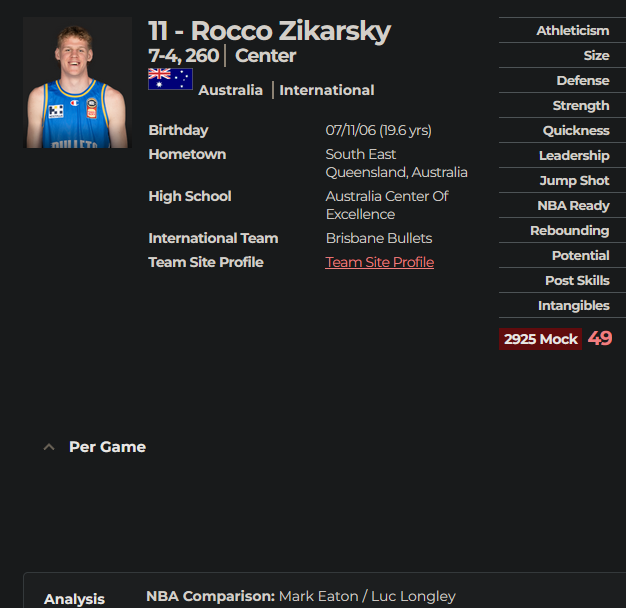
Superficially, Zikarsky is extremely tall, extremely white, and extremely Australian. The two comps the site gives are Mark Eaton (extremely tall, extremely white) and Luc Longley (all three). I guess it's technically "analysis", but crap like this undoubtedly does more harm than good. People who read analysis like this are less well-informed about the NBA for having read it. Bad data can be a lot worse than no data.
The site loves intra-racial comparisons, to the point that it almost seems like a running joke.
Their comps for Johnny Furphy are Sam Dekker and Gordon Hayward, two more white guys. Gradey Dick also gets compared to Hayward. Egor Demin is compared to Josh Giddey and Svi Mykhailiuk. Danny Wolf is compared to Henry Ellenson and Moritz Wagner. Brooks Barnhizer is compared to Dean Wade. Reed Sheppard is compared to Mark Price and Jimmer Fredette. Donovan Clingan is compared to Jakob Poetl and Walker Kessler. Chet Holmgren is compared to Kristaps Porzingis. Christian Braun is compared to Chase Budinger. Nikola Jokic is compared to Nikola Vucevic.
Kon Kneuppel is compared to Chris Mullin, another white guy, and Jared Dudley, a light-skinned black guy. That's as close to color-blind as they get.
The one that makes me think it's trolling is Ryan Kalkbrenner being compared to Ante Tomic, who I had to look up. He never played a minute in the NBA but was drafted in the 2nd round in 2008. How is that comparison useful for an NBA fan, when describing a player drafted in 2025? Anyone with enough hoops knowledge to know Ante Tomic should be able to think of a comparison that actually played in the league.
Sheesh. Nearly all these comparisons are laughable based on how the guys actually play. If their player comps are so obviously bad and biased, why should anyone trust the rest of their analysis? I'm not really a fan of the draft preview subgenre of sportswriting and am admittedly not the target market. Maybe the predictive power of the stories doesn't matter, like with gambling podcasters, and their cool bro stories. Why is this the story that draft enthusiasts want to hear?
Quick math time
Around 1 in 5 NBA players are white. Unless you assume there's some link between race and basketball playing style, the chances of a player's two best comps both being white should be 1 in 25, or 4%. The chances of a player having two black comps should be 64%, or 16x higher.
There should be 4x as many black players with two white comps than white players with two white comps, because there are 4x as many black players overall. Yet I've never seen a black player get two white comps, and it's pretty rare for a white player to get two black comps. Usually the comps aren't quite as blatantly biased as this site's, but there's always a little stench of it.
Last year, there was some controversy when Isaiah Hartenstein described himself as "bright skinned", because his father is half Black. Now, I have zero authority, and even less desire, to judge who should call themselves Black or not. But we can use this crappy website to make a Cleveland Browns-style data driven decision on the matter. Hartenstein's pre-draft comps? Donatas Motiejunas and Dino Radja, two white guys. That settles it!