Dec 31, 2025
Song: Bohannon, "Save Their Souls"
Nothing this week, as I'm working on a couple big things about the NFL.
Mathletix Bajillion, see you next year edition
One mathletix team picks bets randomly, the other algorithmically.
Both teams took Washington +7, which ended up being a push. The line closed at +9, so they both missed out on a win by taking the bet early in the week. The Mcaul-Stars also lost the bet on JAX -6.5, who won by 6 points. The closing line was JAX -4. So they could've been 3-2 on the week, instead of 1-3-1.
Both games are good examples of the fact that closing lines aren't necessarily more accurate than the opening lines, something I've covered before. Of course, bettors taking the opposite side of Washington and Jacksonville would've been better off taking the lines early in the week. Whether line moves hurt or help will depend on which side of the line the gambler is on.
Lines taken Thursday morning.
The Neil McAul-Stars
last week: 1-3-1, -209
Overall: 21-18-1, +245
line shopping: +125
- LAC +13 -109 (prophetX)
- CAR +3 -110 (prophetX)
- GB +8 -110 (hard rock)
- KC -5 -110 (prophetX)
- CIN -7.5 -101 (prophetX)
The Vincent Hand-Eggs
last week: 2-2-1, 0
Overall: 15-22-3, -787
line shopping: +133
- JAX -12.5 -110 (prophetX)
- CAR +3 -110 (prophetX)
- DET +3 -110 (lowvig)
- BUF -7 -105 (lowvig)
- NE -10.5 -102 (lowvig)
Dec 23, 2025

Song: Light-Space Modulator, "These Things"
Notebook: https://github.com/csdurfee/csdurfee.github.io/blob/main/notebooks/super-contest.ipynb
Even the experts can't do it
As I've been chronicling in the "Bajillion" segment, experts are really bad at betting on NFL football, or at least the ones at the Ringer are.
That inspired me to make my first YouTube video, about sports gambling and why it's not really a game of skill. I'm still working on it, but I promised I'd do a thing a week on here. This is that thing.
The Ringer's football/gambling experts doing worse than a coin flip on the NFL could just be coincidence, bad luck, or as gamblers say, a bad beat. I figured I should make more of an effort to find real-world betting records on the NFL by people who have might skill as gamblers, rather than people who talk about sports for a living.
The Westgate Resorts (TM) Las Vegas Super Contest (R) seemed like the perfect testing ground. It's exactly like the Ringer 107, except there's cash on the line. With a buy-in of $1500 and around 1,000 teams a year, that's a pretty nice top prize. (There are fewer contestants this year than normal, maybe because the buy-in increased from $1,000.)
While the people at the Ringer are using their picks to generate interesting football content, these contestants have lot of financial incentive to do well and nobody they have to explain their picks to. The Ringer writers might have a bias against taking the uglier/harder to justify side of a bet, because their job is really to tell a story that people want to listen to. But these folks should be eating W's like crab legs and not caring how messy it looks.
That $1500 buy in is 207 hours of wages, pre-tax, for someone making the federal minimum wage. For regular folks, $1500 is most of a mortgage payment, or a few months of groceries. Anyone risking that much money should have rational reasons to believe they're good at betting on football, right?
This isn't a non-gambling football writer forced to make picks for the sake of content. The contestants consider themselves sharp enough to beat 1,000 other competitors in a pretty famous betting contest, for a Million dollar payout and the chance to get their photo taken with a bunch of showgirls while holding a giant novelty check.
This is the kumite of football betting, the ultimate contest of warriors, and I assume you're only going to enter the kumite if you've won a few fights before.
Mind you, there are around 15 NFL games every week and the teams only have to pick 5 of them for the Super Contest. Maybe most lines are so fair nobody can make money betting them, but the contestants only need to take one game in three. If there are any lines that are beatable, these contestants should be finding them. Their win rate should be an overly optimistic estimate of how beatable the average NFL line is, because they're not taking every game, or random games.
My assumption before running the numbers was that this was a contest for people who should have a decent chance of at least breaking even (over 52.4% winning percentage.)
The terrible, horrible, no good, very bad year
That assumption hasn't been even close to true this season. Data as of week 16 taken from the Westgate Resorts website.
There are 751 entrants in the 2025 contest. 59% of them (444/751) have a losing record. 76% of them would be losing money, if they were taking their picks at -110 odds.
Collectively, the teams have won 48.6% of their bets. It might not sound terrible, but there are 700+ teams who have taken 70 bets apiece, so it's a big sample size overall -- over 54,000 bets in total. Statistically, they're much worse than flipping a coin. If you flipped a coin 54,000 times and it came up heads 48.6% of the time, you'd be safe concluding it wasn't actually a fair coin.
Here's one way to visualize the suckitude. I simulated each team making picks by flipping a fair coin, and compared them to the actual results.
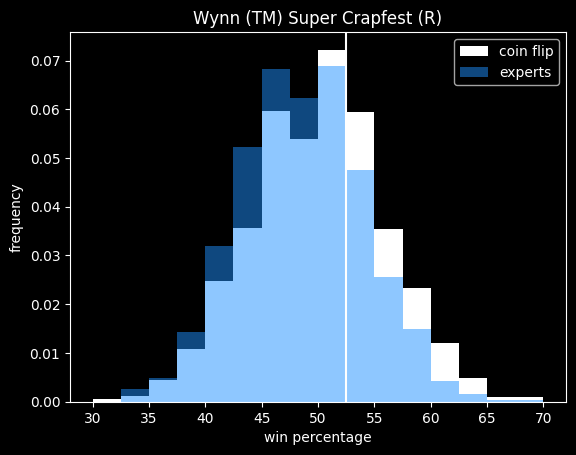
The white areas are where there were fewer real competitors than we'd expect by random chance, the dark blue parts are where there are more real competitors than expected, and the light blue is the overlap.
The white vertical line is the minimum winning percent to break even at standard -110 odds. Most of the white area, where there are fewer competitors than expected, is to the right of the line, and all of the dark blue area is at less than 50% winning percentage.
Anti Skill and Uncle Juice
The best entry in the contest is sitting at 53-21, the amusingly named BIFFS ALMANAC. That record would be an outlier if we were selecting bets by chance, so even though it's a small sample size, kudos to them, and their mostly accurate sports almanac.
The worst record belongs to the also amusingly named THISSHOULDBEEASY, with a record of 24-49. If that team had just taken the opposite of their bets, they'd be in 2nd place!
Most of the teams would be doing better if they wrote down their best picks, then took the opposite of them. Knowing stuff sure seems to be a disadvantage when betting on football.
In aggregate, whatever strategies or football knowledge or divination rites (*) the contestants are using makes them worse at picking winners -- they possibly have anti-skill. This is sort of what the efficient market hypothesis predicts -- picking stocks randomly (or index funds, which invest in every stock on the market) will generally outperform mutual funds that have professional fund managers making the picks.
(*) I'm a big tyromancy guy myself. RIP to the recently departed Claude Lecouteux, a legendary historian of spooky medieval stuff. If you ever need to write a heavy metal concept album on short notice, his books are a goldmine.
Previous years
After a bunch of wasted work to screen-scrape results from previous years off 3rd party sites, I discovered another website that has the complete records going back to 2013 in CSV format. Score!
This season has been particularly difficult on Super Contest gamblers, which probably explains the Ringer's poor record. Previous seasons have looked more like what I expected -- the average Super Contest entrant is a little better than flipping a coin, but not good enough to actually make money gambling.
Here are the Expected Values by year:
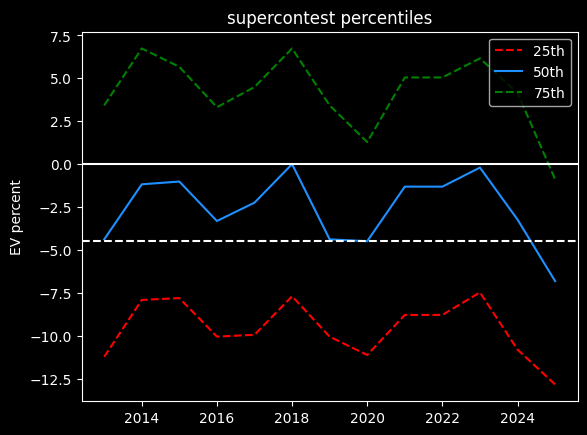
The dotted line is at -4.5%, the Expected Value (EV) of taking a bet at -110 with a 50% chance of winning. There have been 5 seasons where the average competitor has done about the same as flipping a coin, or worse, and 2 seasons where they came close to breaking even.
Over all seasons and all contestants, the average EV is -2.5%, about the same as betting 'reduced juice' (-105 odds instead of -110) with a 50% chance of winning. Overall, the EV has been better than what we'd expect by chance, but not good enough to be profitable.
Since the contestants only have to pick 5 games every week, this data should represent the best case scenario -- the most beatable lines possible, being taken by more experienced than average gamblers -- and they're still losing money 11/13 years, and breaking even the other two.
While the 75th percentile has a decent rate of return (up until this season), that's true of flipping a coin as well. With fewer than 100 bets in a Super Contest season, it's very possible to have a winning record by chance alone.
The win rate of competitors has been going down for 3 years in a row. It may be due to weaker competition in the Super Contest, or just random variation, but I would guess it's at least partially due to better lines. More money than ever is being gambled, and there's more information than ever, so the lines should get tighter. I would have to pull a lot more data to answer that question, though.
Looking for other experts
OK, maybe that's still not enough proof -- what about people who make a living selling their supposed gambling expertise? I've looked at a ton of sites that sell picks for money, so I have an idea how this will go. But I came across a new one that's run by some pretty smart folks, so let's give it a crack, and I'll try to act suprised at the results.
The site in question is called FTN Fantasy. It's affiliated with Aaron Schatz, who I'm pretty sure basically invented modern football analytics with his site Football Outsiders.
DVOA, ever heard of it?
If football betting is a game of skill, a game of ball-knowing (at least the stats version of ball-knowing), he should have that skill. Here's Aaron's record:
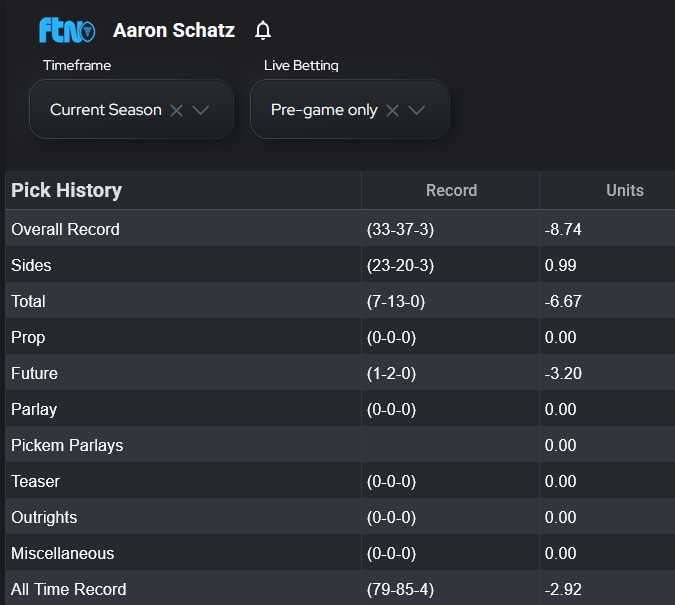
Oh no! He's got a losing record overall, a -11% EV on his bets (vs. -4.5% for picking which mascot would win in a fight). Who could have seen that coming?
Here's the whole site's record:
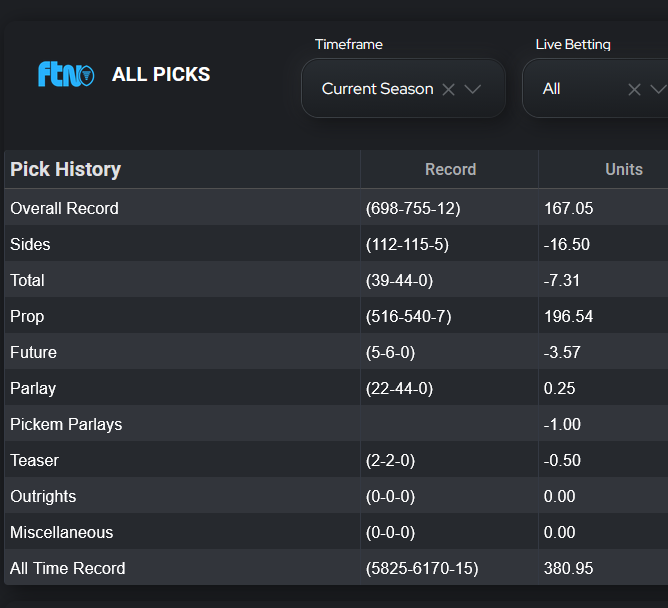
While they have a winning record overall, they have a losing record against the spread (the bets labeled Sides).
Giving them props
Prop bets are, well, propping their record up. Since the site is primarily about fantasy football, it makes sense they would be strong on prop bets, since fantasy is all about individual player predictions. That makes them a cut above most tout sites, who aren't good at anything.
It's quite possible that prop bets are beatable in a way spread bets aren't, though as discussed in the video, the big sportsbooks no longer allow taking the unders on prop bets, which I'm sure makes it harder to find value.
My caveat about tips on prop bets is that the lines tend to move very rapidly, and in large amounts. A line could very quickly go from positive to negative Expected Value before someone could get a bet down. So the tips might be legit, but not be usable to the gambler paying for them -- they have a very short shelf life.
Touts and their tricks
The only tout with a good record against the spread is esteemed actor Michael Chiklis apparently doing a little moonlighting:
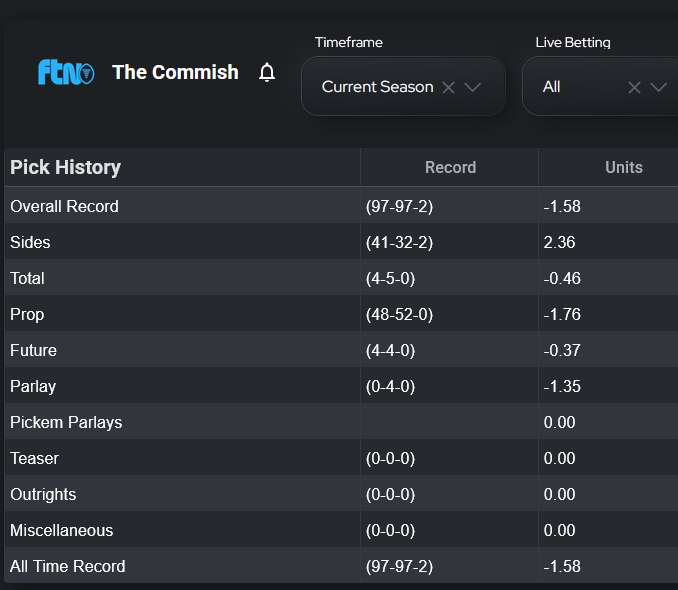
The Commish is doing something I've seen a lot of touts do, which is taking some games at higher than -110 odds in order to make the win-loss record appear better (for example, buying a couple of points and taking -150 odds, which should win significantly more than 50% of the time). The equivalent record at -110 odds would be 41-35, only a 54% winning percentage. That's better than nothin', but it ain't much.
I'm inclined to be distrustful of any tout pulling that trick, since buying points is a negative Expected Value play. (We don't need math for this one: the sportsbooks wouldn't offer the option of buying points if it was positive EV for the gambler. They're counting on the gambler making an emotional decision to buy the points, because they've done the math and know it's a bad deal.) Buying points might make the record look better, but it will hurt profits/increase losses over the long run.
Bajillion, Week bajillion
One mathletix team picks bets randomly, the other algorithmically.
The Ringer had another losing week, going 12-13 overall, despite one team going 5-0. Mathletix went 6-3 on the week, despite a couple of bad beats (bets that just barely lost).
Lines taken on Tuesday morning.
The Neil McAul-Stars
last week: 4-1, +295
Overall: 20-15, +454
line shopping: +104
- WAS +7 -104 (lowvig)
- MIN +7 +103 (prophetx)
- GB -2.5 -112 (lowvig)
- TEN +2.5 +102 (prophetx)
- JAX -6.5 -106 (prophetx)
The Vincent Hand-Eggs
last week: 2-2-1, -6
Overall: 13-20-2, -787
line shopping: +113
- PIT -3.5 +103 (prophetx)
- HOU +2.5 -108 (prophetx)
- WAS +7 -104 (lowvig)
- ARI +7 -101 (prophetx)
- BAL +2.5 +101 (lowvig)
Dec 17, 2025

Song: "Pacific State (12" version)", 808 State
Two Georges, damn
In the NBA right now, there are two up-and-coming players with very similar names. This seems to keep happening in the league. I wish somebody would do something about it.
For a few years now, we've had to deal with two players named Jaylin Williams and Jalen Williams who play on the same team and have similarly generic nicknames, forcing hoops fans to remember which one is "J Dub" and which is "Jay Will". This is on top of a dozen other "Jalens" playing for other teams as well. (Do Jalen Rose or his parents get any residuals for all these basketball Jalenses? I hope so.)
Compounding the problem for Keyonte George of the Utah Jazz and Kyshawn George of the Washington Wizards is the fact they play for two of the worst teams in the league. There's only so much Jazz/Wizards basketball anyone can watch and stay sane, so even avid hoops fans should be forgiven for doing a "Christian Bale"/"Kirsten Bell" thing with them. Even pro sports journalists do that.

Both started out looking like they were drowning in the NBA, but they're putting it together, Kyshawn in his second season, Keyonte in his third, so it's time to tune in while you can still say you knew about them before it was cool.
Kyshawn
Kyshawn George is a floofy haired youth who always looks like he's 15 minutes late to his Political Science class. He should probably be playing in a North Face puffy jacket and pajama pants instead of a Wizards uniform.
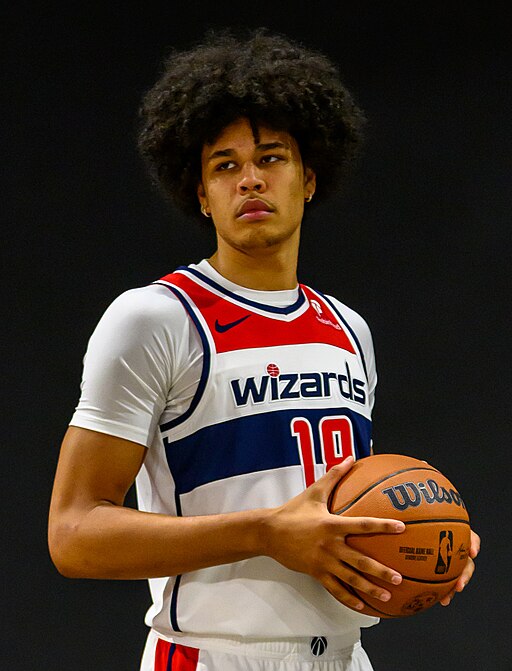 All-Pro Reels, CC BY-SA 4.0 https://creativecommons.org/licenses/by-sa/4.0, via Wikimedia Commons
With the big hair and the throwback Wizards jersey, he looks a little bit like greatest player in Washington Bullets/Wizards history, Wes Unseld:
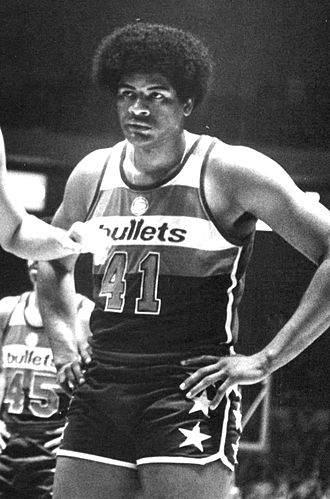
His game is a little Unseld-y, too. Unseld was a 6'7" guy who played center. Guarding much bigger players takes a certain quality -- solidness -- that not all players have. Some guys just occupy space better than others.
Although he plays small forward, Kyshawn George has that solidness. At his best, Kyshawn just kind of owns the floor, unafraid to bounce off of other players (or go through them) in order to score or get the rebound. And like Unseld, he has good passing skills. If Wes Unseld played today, he might be a point forward like Kyshawn, who is leading the Wizards in assists.
At his worst, well, Kyshawn's got a lot to learn. I think he has the capability to be a very good defender, but the Wizards are just awful at defense -- worst in the league by points allowed. It's hard for me to tell how good a player is when they're surrounded by teammates who make lots of defensive mistakes.
Keyonte
Keyonte George, looks a bit like, I dunno, Timon from the Lion King. I don't have Timon's scouting report, but Keyonte's a super quick modern point guard who can score as well as set his teammates up. Or at least that was the idea. His first two years in the league were disappointing. He mostly shot 3 pointers, and wasn't especially good at it. As a point guard, he was tentative, and seemed to check out mentally at times when things were going bad (a frequent occurence on the woeful Jazz.)
This year, he's more of an all-around scorer, and much more efficient. He's scoring almost 6 more points per 36 minutes, while only taking 1.7 more shot attempts. A lot of that is driven by getting more free throws -- 3 more made free throws per 36 over last season. He's a threat to score from just about everywhere, after two seasons of not being a threat anywhere.
Keyonte's still bad on defense. The Jazz are 28th in Defensive Rating, so like Kyshawn, it's awfully hard to say how good he really is when he plays on such a crappy team. His game is similar to DeAaron Fox, who is currently thriving on the Spurs surrounded by significantly above average defenders. So I think he has a bright future even if he never makes a big leap on defense.
7'6" man kills giant
Shout out to the try-hard Spurs for taking down the Thunder in the NBA cup. The fact that the tallest guy in the NBA took down basketball Goliath is perfect. No notes. My biggest basketball fear is that if the aliens come down and challenge Earth to a game, we're not gonna have anyone who can guard Wemby.
Mathletix Bajillion, week I guess we're still doing this
As usual, one of these teams picks randomly, the other algorithmically.
The Ringer went 9-16 on the week, for a 171-204 combined record on the season and 45.6% winning percentage. The mathletix teams didn't cover themselves in glory either, going 3-7. Nobody knows nothin'. All of us are in the gutter, but some of us are staring at the reduced juice.
Lines taken Wednesday afternoon
The Neil McAul-Stars
last week: 1-4, -321
Overall: 16-14, +159
line shopping: +99
- SEA -1.5 -105 (prophetx)
- TEN +3 +100 (lowvig)
- CAR +3 -106 (prophetx)
- NE +3 -108 (lowvig)
- ATL -3 +100 (prophetx)
The Vincent Hand-Eggs
last week: 2-3, -110
Overall: 11-18-1, -781
line shopping: +99
- SEA -1.5 -105 (prophetx)
- JAX +3 +103 (prophetx)
- MIN -3 +109 (prophetx)
- LAC +2 +106 (lowvig)
- GB +0.5 -110 (prophetx)
Dec 02, 2025

Song: Hobo Johnson, "Sacramento Kings Anthem (we’re not that bad)"
Stats are as of 12/1/2025. Spreadsheet here
The Kings
The Sacramento Kings are going through it. Again. For most other teams, the choices they've made recently would be a historically incompetent period, a basketball Dark Ages. For the Kings, it's just another season.
Firing the only coach that's had success with the team in a long time and replacing him with a buddy of the owner who is willing to work cheap. Drafting two All-Star point guards and trading both of them away. Trading for two guys (LaVine and DeRozan) who everybody knew would be a bad fit from their years playing together on the Bulls. Trading the very good, ultra reliable Jonas Valančiūnas for the washed Dario Saric just to save a tiny bit of money.
Do you know the definition of insanity? The Kings' front office doesn't.
Sacramento is 5-16 so far. They're definitely not a good team, but maybe they're not that bad? They went 40-42 last season, which is respectable in the loaded Western Conference. They've had a brutally hard schedule, and 21 games is not a large sample size.
I'll get back to the Kings, but first, the other side of the coin.
The Heat
The Miami Heat were arguably in a worse place than the Kings at the end of last season. They won 37 games, 3 fewer than the Kings, and play in the easier conference. They looked totally checked out by the end of the season, another team stuck in the middle of the NBA standings.
It was a disappointing, dysfunctional run where they traded away their best player and seemed to be going nowhere. The vibes were bad, but they didn't blow up the team for the hope of maybe being good again someday, or run back the same players and the same scheme for another bout of mediocrity. Instead, they trusted the culture they built and tried something innovative.
They've been one of the best stories in the NBA so far, greatly outperforming expectations by playing a radical brand of basketball on the offensive end. They completely overhauled their offense to quickly attack one-on-one matchups before the defense can get set, rather than the traditional approach of creating mismatches using pick-and-rolls.
Here's a good video from Thinking Basketball explaining the strategy, an even more turbo-charged version of the scheme the Grizzlies used to great success last year. As a basketball fan, it's a bit weird to watch at first, because pick and rolls are such an traditional part of basketball, but it's refreshing.
I don't know why more teams don't have the courage to try unconventional things -- or in the Grizzlies' case, stick with something unconventional that was working. In the NBA, it takes a great coach and front office to defy the conventional wisdom and try to get more out of the players already on the roster -- putting them in a position to succeed rather than re-shuffling the deck.
The most remarkable part is that overhauling the offense hasn't sacrificed the Heat's identity as a top-tier defensive team at all. They have the 4th best defense in the league so far by Defensive Rating. They're doing this while playing at the fastest pace in the league this year. Teams that play fast are usually just trying to outscore their opponents, with little attention to defense.
But the Heat are using their scheme to generate high quality offensive opportunities for players that are primarily on the court for their defense. They're building on their core identity rather than changing directions entirely. They're building on strength.
An elite playmaker like Tyrese Halliburton, or a generational talent like SGA or Jokic, can set up defense-first players for easy looks, but most teams that concentrate on defense struggle generating enough offensive firepower. The Orlando Magic have been plagued by that problem for years. The system Miami is running seems like a cheat code for defensively minded teams -- at least until the league inevitably figures out ways to slow it down.
I couldn't find anybody in the media who knew the Heat's scheme change was coming, much less an idea of how much of an impact it would have. I looked at a bunch of preseason power rankings, and they were all pretty down on the Heat for the same reasons, without any hint that they could fix the problems with a different play style. It's much easier to assess the impact of roster changes.
For example, this is from NBC Sports' preseason power rankings:
this was a middle-of-the-pack Heat team last season that made no bold moves, no massive upgrades, leaving them in the same spot they were a year ago.
Here's Bleacher Report's
for an offensively challenged team, replacing [Tyler Herro's] scoring (21.5 points over the last four seasons) and distribution (4.6 assists in the same span) is going to be tough.
And USA Today's:
Losing Tyler Herro for the first two months of the season, potentially, comes as a significant blow to a team that struggled to score — especially late in games — even when he was on the floor.
With the change in style the Heat are still only a mid-tier team on offense, ranking 14th in Offensive Rating. But that's a big step up from last year, when they were 21st, especially given they haven't had their best offensive player for the first month of the season.
Are they going to win a title with the present roster? No, but in addition to giving their fans something to cheer for, all their players will look much better on paper than they did at the start of this season. If they do decide to trade players, the Heat can get more in return for them. And it's not hard to get free agents to move to Miami if the team is winning and the vibes are good, so they could be a real contender again quickly.
It's weird that tanking is seen as the best way to increase the chances of future success in the NBA, rather than building a winning culture and innovating. The two teams with the most success in recent years at doing a major rebuild have been the Spurs and the Thunder. They were both bad for a few years, but they're also two of the best run teams in the league. They draft well, they trade well, they do player development well, they do analytics well. They had a clear vision of the type of team they wanted to build and the clear ability to develop players. If a team doesn't have those organizational competencies, what's the point of a tank? They're just going to waste their high-level draft picks, not develop the rest of the roster, and be mediocre again in 5 years.
Power ranking the power rankers
I collected data from six preseason NBA power rankings. There's a link to the spreadsheet at the top of the article. I would've liked to collect more data, and I'm sure there are other sites that did good NBA power rankings, but stuff like that is basically impossible to find these days, lost in a sea of completely LLM generated baloney or locked behind paywalls. It's not useful interrogating why some LLM stochastically decided that the Warriors are the 4th best team in the NBA this year, but there's seemingly an endless supply of that type of nonsense. Which is to say: thanks for reading this, however you managed to get here. I hope you'll keep coming back for this completely human generated baloney.
I compared the rankings from each list to each team's point differential, which is a better estimate of how good a team is than their win-loss record. How good were our mighty morphin' power rankers at predicting the current standings?
So far, the most accurate ranking has been RotoBaller's, with a Spearman correlation of .76. The worst has been USA Today, at .69. Taking the median rank of all six sources produced a correlation of .74, which was better than 5 out of the 6 individual scores. So we're getting a "wisdom of crowds" effect, which is interesting, since all the rankings are fairly similar to each other. (Previously discussed in Majority voting in ensemble learning.)
I also included rankings based on my own preseason win total estimates. I got a score of .73, right in the middle of the pack. That's respectable, but I can't believe I'm getting beat by the freaking New York Post.
Comparing rankings to records, the power rankers were too high on the Clippers, Cavaliers, Pacers, Kings and Warriors. They were too low on the Raptors, Suns, Heat, Spurs and Pistons.
Strength of schedule
Scheduling matters. Some teams have played much harder schedules than others, and we're dealing with small sample sizes, so win-loss records can be deceiving early in the season.
I grabbed adjusted Net Rating (aNET) data from dunksandthrees, which calculates the offensive and defensive ratings for each team, adjusted for strength of schedule. I also included Simple Rating System (SRS) data from basketball-reference, which is the same idea as aNET, but a different methodology.
The difference between aNET and average point differential gives a sense of which team records might be the most misleading compared to the team's actual skill level. For instance, the Sacramento Kings have already played the Thunder, Nuggets and Timberwolves three times apiece, going 2-7 over those games. Even a decent team would be expected to have a losing record against those opponents.
Based on aNET, the Cavaliers, Warriors, Clippers, Kings and Celtics are probably better than their records indicate.
Going the other way, the Raptors have had a deceptively easy schedule, going 7-1 in games against the woeful Nets, Hornets, Pacers and Wizards. Going 7-1 doesn't tell us much, because those are teams pretty much everybody should be able to beat.
The stats indicate that the Raptors, Hornets, Spurs, Jazz, and Suns are probably not as good as their records.
Most of the teams the power rankers got wrong have been hurt or helped significantly by their schedules so far. The biggest exception has been the Miami Heat, who apparently nobody saw coming, and are probably about as good as their record says they are.
The Kangz
What to make of the Kings? According to basketball-reference, they've had the hardest schedule in the league so far. It's fair to say they're not as bad as the record says.
While they're 28th in point differential, they're 25th by aNET, and 26th by SRS. So they might have 7 or 8 wins instead of 5 if they'd played a league average schedule. That's not that much, though, and a clear step back from last year.
Their rookie, Nique Clifford, has not looked good so far, and they don't have many players that other teams would want in a trade. It doesn't seem like they have any clue of how to develop young talent. Their highest paid player, Zach LaVine, has another year on his contract, doesn't play defense, and has put up a -1.1 VORP this year. They just benched their one big signing of the offseason (Dennis Schröder), and are instead starting Russell Westbrook, a man born during the Reagan Administration playing on a one year minimum deal.
On paper, they don't have much they can do to get better. But everybody was saying that about the Heat at the end of last year, and look at them now. I just can't see the Kings having that type of organizational courage, but I hope they find it somehow rather than spend years on another doomed rebuild. Sacramento fans deserve better than another version of the current mess. At least an innovative mess would be a change of pace from trying the same stupid thing over and over. What's the worst that could happen?
Sacramento's roster isn't great, but like the Grizzlies, the biggest problems I see are organizational. I understand the Kings are a rich man's toy, not a serious basketball team, but wouldn't it be more fun to own a team that wasn't a giant tire fire? I don't get spending billions of dollars to buy a sports team just to run it into the ground like this.
The Mathletix Bajillion, week 5
As usual: One of these teams picks NFL games randomly, the other uses a simple algorithm.
4 of 5 Ringer 107 teams had a losing week, going 10-15 collectively. All five still have a losing record on the season, so right now the McAul-Stars are the undisputed leaders.
Bluster aside, the important thing to notice is how much they're saving taking cheaper lines than the standard -110 odds. The McAul-Stars would be up +110 instead of +176 if the bets were taken at a retail sportsbook, and the Hand-Eggs would be down -620 instead of -563.
Lines taken Tuesday morning. Since it's early in the week, the reduced juice isn't quite as juicy as usual.
The Neil McAul-Stars
last week: 4-1, +296
Overall: 11-9, +176
line shopping: +66
- SEA -7 -108 (lowvig)
- DAL +3 -104 (prophetx)
- CIN +5.5 -108 (draftkangz)
- JAX +2 -108 (prophetx)
- LAC +2.5 +108 (prophetx)
The Vincent Hand-Eggs
last week: 1-4, -316
Overall: 7-12-1, -563
line shopping: +57
- WAS +1.5 +100 (lowvig)
- CIN +5.5 -108 (draftkangz)
- LAR -8 -101 (prophetx)
- DEN -7.5 +100 (lowvig)
- CLE -3.5 -108 (prophetx)
Nov 19, 2025

Song: Talking Heads, "Cities", live at Montreaux Jazz Festival, 1982
What's going on with the Grizzlies?
The easiest answer is they're miserably bad on offense. It's also the oddest thing about this team to me, since they scored effortlessly last year. The Grizzlies had found something that worked last season. They had the 6th best Offensive Rating, and 10th best Defensive Rating. Considering the Indiana Pacers made it within one game of winning the NBA Championship with the 9th best Offensive Rating and 13th best Defensive Rating, the Grizzlies were definitely a borderline contender.
This year, they're 27th in Offensive Rating, 21 positions worse than last year. (The falloff on defense is a little more understandable, since they have several very good defensive players injured right now.)
eFG+ is a measure of effective FG%, normalized so that 100 is league average. Here are the top 8 Grizzlies players by minutes played the last two seasons:
| Position |
2025 |
2024 |
2025 eFG+ |
2024 eFG+ |
Diff |
| Center |
Jock Landale |
Zach Edey |
108 |
111 |
-3 |
| PF |
Jaren Jackson Jr |
Jaren Jackson Jr |
98 |
101 |
-3 |
| SF |
Jaylen Wells |
Jaylen Wells |
82 |
97 |
-15 |
| SG |
KCP |
Desmond Bane |
77 |
104 |
-27 |
| PG |
Ja Morant |
Ja Morant |
71 |
93 |
-22 |
| Bench 1 |
Santi Aldama |
Santi Aldama |
96 |
106 |
-10 |
| Bench 2 |
Cedric Coward |
Scottie Pippen Jr |
105 |
102 |
3 |
| Bench 3 |
Cam Spencer |
Brandon Clarke |
109 |
115 |
-6 |
Except for rookie Cedric Coward, every single slot is a downgrade. Wells and Aldama have been significantly worse than last season, but the most dramatic is Ja Morant. The only player with around as many minutes played and a lower eFG+ are Ben Sheppard and Jarace Walker of the Indiana Pacers, young players who have been forced into playing a lot of minutes due to injuries.
Where have all the backup PGs gone?
A big problem for the Grizzlies is that they don't really have a backup point guard. They're far from the only team with a lack of PGs on the roster this season.
The Dallas Mavericks have been playing rookie forward Cooper Flagg as PG even though they knew their starting PG, Kyrie Irving, was injured coming into the season. The Nuggets have been experimenting with having forward Peyton Watson as backup PG. The Houston Rockets have no true PG in their "oops, all bigs" starting lineup, though Reed Sheppard is playing more and more off the bench, and looking pretty good.
It's an odd trend to me. Backup point guards have traditionally been cheap and easy to find -- guys like Ish Smith and D.J Augustin. They're like small, functional trucks. They made a ton of them back in the day, but they kinda don't exist anymore, despite how useful and reasonably priced they were. Does that make Yuki Kawamura the Kei truck of this analogy? Yes, yes it does.
The Rockets and Nuggets are doing fine so far without playing a backup PG, but the Grizzlies' situation is just baffling to me. Ja Morant is one of the more injury prone players in the league. You didn't think you needed to find a real backup for him? (Wouldn't Russell Westbrook look good in a Grizzlies uniform?)
The Grizzlies have a stretch of easier opponents coming up, so I think they'll start looking a little better for that reason alone. Maybe they'll get some mojo back. But I'm always about process, rather than outcomes, and I just don't get the Grizzlies' process right now. They had something pretty cool going last year, and now they don't.
Teams can't control a lot of factors. Injuries, who they play on a given night, the bounce of the ball on the rim on a last second shot. There's a lot of luck. But the Grizzlies' problems seem to come down to things the coaching staff and front office can control: vision, planning, vibes, communication, style of play.
Mathletix Bajillion, week 3
One of these teams is random, one is chosen by an algorithm put together by me, a non-football guy. Can you guess which one is which?
All lines are as of Thursday morning.
The Neil McAul-Stars
last week: 1-4, -301
Overall: 6-4, +203
line shopping: +43
- PIT +2.5 -105 (lowvig)
- GB -6.5 +100 (lowvig)
- NO -2 -108 (prophetx)
- TB +6.5 +101 (prophetx)
- PHI -3 -110 (hard rock)
The Vincent Hand-Eggs
last week: 2-2-1, -10
Overall: 3-6-1, -344
line shopping: +16
- CIN +6.5 -107 (rivers)
- CHI -2.5 -105 (lowvig)
- ATL +2 -102 (prophetx)
- BUF -5.5 -101 (prophetx)
- DET -10.5 -102 (prophetx)
Nov 18, 2025

Song: "Round 6", by Prince Jammy
A few interesting statistics from the first dozen games of the 2025-26 NBA season.
I'm generally talking about stats per 100 possessions, rather than raw stats (unless otherwise noted).
The absurd OKC Thunder
The OKC Thunder have been a godless basketball killing machine this year. Almost every win is a blowout, despite their second best player being injured. They look like they don't even have to try all that hard, and they're winning by an average of 16 points.
To me, their secret sauce is that they make it nearly impossible to score against them. There are no easy buckets. Here are some good ways to get easy points in the NBA:
- make lots of 3's
- get lots of free throws (and make them)
- take a lot of shots close to the basket
- get points off of turnovers
- get out on the fast break
- get second chance points
The Thunder are middle of the pack at the first two. They're only 15th in 3 pointers made against them per game, and 12th in free throws given up.
They're ridiculously elite at everything else that makes scoring hard. The Thunder are first in the league at:
- Defensive Rating
- Defensive Rebounding
- Steals
- Fewest opponent fast break points
- Fewest opponent points in the paint
- Fewest opponent points scored
- Lowest opponent effective FG%
They're second in the league at:
- Fewest turnovers
- Fewest opponent points off turnovers
- Fewest opponent 2nd chance points
- Fewest opponent assists
- Most opponent turnovers
The most remarkable part is how they've built their team. Their 3rd and 4th leading scorers, Ajay Mitchell and Aaron Wiggins, were both 2nd round draft picks. Their 5th leading scorer, Isaiah Joe, was a 2nd round pick by the 76ers who got waived, then refurbished by the Thunder like an estate sale armoire. Their best defender, Lu Dort, went undrafted.
The team just finds a way to bring the best out of players that any other team could have had. What did they see that everybody else missed, and what did they do to develop them?
As a fan of another NBA team, and someone who lived in Seattle in the 15 years after the Sonics were stolen away to OKC, I want to get off Mr Presti's Wild Ride. But statistically, it's great.
Bucking trends
Victor Wembanyama is by far the best shot blocker in the NBA, averaging 3.6 blocks a game. But the Spurs are only 6th overall in blocks. Nikola Jokic is by far the best passer in the NBA, but the Nuggets are only 5th overall in assists. Steph Curry is the best 3 point shooter of all time. But the Warriors are only 12th in 3 point percentage. This isn't all that surprising. Just because one player is good at a particular skill, that doesn't mean the rest of the team is.
What's more surprising to me is that Giannis Antetokounmpo draws the most free throws in the league, but the Bucks are 28th in free throw attempts. Teams that get a lot of free throw attempts tend to attack the basket a lot, or be the Los Angeles Lakers. The Bucks are weird because pretty much only Giannis does anything free throw-worthy. At the time I wrote this, Center Myles Turner had not shot a single free throw in his last 63 minutes of game time. That doesn't seem like a recipe for success for the Bucks.
Basketball is broken
And I know the guy who did it: Nikola Jokić. Advanced stats aren't everything, but right now he has a Win Shares per 48 (WS/48) of .441. Win Shares are probably a little biased towards big men who score efficiently, and affected by the pace of the game. That aside, it's a pretty good stat as far as having a single number to quantify how good somebody is at basketball. It correlates pretty strongly with actual basketball watching, I think. The top players in WS/48 are usually the top candidates for the MVP every year. And it matches who we think the best players are historically.
Last year, the top player by WS/48 was Shai Gilgeous-Alexander, at .309. The year before, it was Jokic, at .299. The year before, it was Jokic at .308. In 2014, it was Steph Curry, at .288. In 2004, when the pace of play was slower, the leaders were Nowitzki and Garnett at .248. In 1994, it was David Robinson, at .273.
Pretty much anything over .250 is an MVP caliber season. There's really no historical precedent for a WS/48 of .441. After 12 games played, Jokic could be the worst player in the league for the next 7 games, and he'd still be having an MVP-type season overall.
Before last game, it was .448. What did Jokic do last game that caused his WS/48 to go down a tiny bit? He got 36 points, 18 rebounds, and 13 assists, on good scoring efficiency and only 2 turnovers. That's a slightly below average game for him right now.
The perils of hand-rolled metrics, pt. 137
I was trying to put together something to show how historically off the charts OKC has been defensively. I started with using a fancy technique, PCA, before realizing that just adding up the ranks of each of the statistics was better and simpler. If one team is 1st in blocks, 2nd in steals, 2nd in opponent points in thde paint, etc., just add the ranks up, lowest score is best.
I ran it on every team over the last 15 years. All of the teams that did well on my metric were good defensively, and the teams that did poorly were putrid on defense. It's not totally useless. But it's a bad way to find the best teams of all time.
Here are the top defensive teams since 2010 by this metric:
- the 2025-26 OKC Thunder
- The 2018-19 Milwaukee Bucks (won 60 games with peak Giannis)
- The 2010-11 Philadelphia 76ers (last Iguodala season, young Jrue Holiday)
- The 2019-20 Orlando Magic (Aaron Gordon and some guys)
- The 2017-18 Utah Jazz (the "you got Jingled" meme team that beat OKC)
Ah well. That's not a terrible list. They were all very good at defense, and made it a big part of their team identity, but I don't think those are really the best defensive teams of the last 15 years. A team's rank by Defensive Rating is still a better predictor of the team's win percentage than my attempts.
There's definitely some Goodhart's Law potential here. OKC are near the top of a bunch of statistical categories, because they are good at defense overall. You can't necessarily get on their level just by trying to copy specific things OKC does well, like prevent fast break points.
We see you, Jalen Duren
More like Jalen Durian, because some of the things he's doing are just nasty. You will definitely get kicked off the bus in Singapore if you're watching Jalen Duren highlights.
Data used
All data from https://www.nba.com/stats/
I had to screen scrape some stuff from their website, since some of the endpoints in the python nba_api package are broken now. See the early-nba-trends.ipynb notebook for code.
Nov 14, 2025

Song: Scientist, "Plague of Zombies"
This is a departure from the usual content on here, in that there's no real math or analysis. There's also not much of an audience for this website yet, so I hope you'll indulge me this week.
I was curious what all these gambling shows talk about for hours, when the picks they produce collectively appear to be no better than randomly chosen. I'm always interested in how people make decisions. How does their process work for choosing what bets to take? How might it work better?
Before I get too far into this, I know I'm being a killjoy. These podcasts are for entertainment purposes, just like betting is entertainment for a lot of people, not a sincere attempt to make money over the long term. Some degenerate gambling behavior is part of the appeal of these podcasts. They're selling the idea that "gambling is fun" as much as any particular bets.
It's still weird to be a gambling expert who can't do better than a coin flip.
I previously showed how combining multiple machine learning algorithms thru voting will only improve results when they make independent mistakes, and are significantly better than guessing. Those are both pretty intuitive conditions, and I think they're true of groups of people as well. If everybody has the same opinion, or makes the same sort of mistakes, or nobody really knows anything, there can't be a wisdom of crowds.
Humans have a big advantage over combining machine learning algorithms. We can talk with each other, challenge each others' assumptions, provide counterexamples, and so on.
There's not a ton of that in the gambling podcasts I listened to. Gambling talk is all about inventing stories about the future. It's sort of a competition for who can pitch the best narrative for the game. These stories are almost their own literary genre, and the construction of these are more important than the picks themselves. There aren't a lot of opportunities for the wisdom of crowds or some sort of error correction to occur.
Imagine I had a magic black box that was right about NBA lines 56% of the time. I could sell those picks, and be one of the better handicappers on the internet. While I could certainly write a little story for each one, maybe in the style of Raymond Carver -- "Will You Please Take The Over, Please?" -- the story doesn't make the bet more likely to be true, though, right? A factual story would be the same for every bet, and not very interesting: "there is slightly more value on this side of the bet, according to the model."
What we talk about when we talk about sports betting
Gambling personalities are always talking about what has happened in the past -- connections to previous games they've bet on, dubious historical trends, and the tendencies of certain players. Interactions like, "I thought you had a rule never to bet against Baker Mayfield?" "But he's 2-7 on the road in early Sunday games after a Monday night game where he got over 30 rushing yards."
These arbitrary connections remind me of a bit from Calvino's Invisible Cities:
In Ersilia, to establish the relationships that sustain the city's life, the inhabitants stretch strings from the corners of the houses, white or black or gray or black-and-white according to whether they mark a relationship of blood, of trade, authority, agency. When the strings become so numerous that you can no longer pass among them, the inhabitants leave: the houses are dismantled; only the strings and their supports remain.
There were quite a few of those useless strings in the November 6th episode of the Ringer Gambling Show.
The top bun
On a couple of occasions, the show discussed whether certain information was already priced into the line or not. Since gambling should be about determining which bets have positive expected value, that's a very useful thing to discuss. "If this spread looks wrong, what does the market know that we don't? Or what do we know that the market doesn't?"
If the goal is to win, the implicit question should always be: why do we think we have an advantage over other gamblers taking the other side? Why are we special? Why do we think the line isn't perfect?
Superstitions and biases
They were resistant to bet on teams that they had recently lost money on -- not wanting to get burned again. This is clearly not a financial choice, but an emotional one. The axe forgets, the tree remembers.
Team loyalty also affected their betting decisions. They avoided taking Baltimore because Ariel is a Ravens fan (the bet would have won). Jon suggested betting against his team, the Dolphins, which Ariel jokingly called "an emotional hedge". The Dolphins won. So they cost themselves two potential wins due to their fandom.
They decided not to take a bet on Houston (which ended up winning) because, in Jon's words, "betting on Davis Mills is not a pleasant experience". Whether a team or player was fun to bet on came up a couple of other times as well. Someone just trying to make a profit wouldn't care how fun the games are to watch. They might not even watch the games at all. Whether the gambler watches the game or not has no influence on the outcome.
Bets need to be fun, not just a good value. These gambling experts still want to experience "the sweat" -- watching the game and rooting for their bet to win. As I wrote last week, betting on the Browns and losing is like losing twice, so even if the Browns are a better value, they are a bad pick for emotional reasons. Who wants to have to be a Browns fan, if only for a few hours?
It's sort of like Levi-Strauss said about food. It's not enough that a type of food is good to eat, it must also be good to think about. The Houston Texans led by Davis Mills are not "bon à penser".
Not enough useful disagreement
All three of the bets they were in total agreement on (PIT, TB, ARI) lost. Nobody presented a case against those bets, so there was no opportunity for any of them to change their minds or reconsider their beliefs.
I'm not endorsing pointless contrarianism -- not every side needs to be argued. Don't be that one guy in every intro to philosophy class. But if both sides of an issue (or a bet) have roughly equal chances of being true, there should be a compelling case to be made for either side. Someone who can't make both cases fairly convincingly probably doesn't know enough to say which case is stronger.
Two types of hot streaks
For gamblers, there's one type of hot streak that's always bound to end. A team has won a few games it shouldn't have won, therefore they're bound to lose the next one. Their lucky streak will fail. In the real world, there's no invisible hand that pulls things down to their averages on a set schedule. In a small sample size of 17 games in an NFL season, there's no reason to think things will be fair by the end, much less the very next game. Now, a team could be overvalued by the market because they got some lucky wins, which makes them a value to bet against. But teams don't have some fixed number of "lucky games" every year, and once they've burned through those, their luck has to turn.
The other type of hot streak is bound to keep going. The team were divided whether to bet the Rams or not. They decided to go with Ariel's opinion, because she's been on a hot streak lately. If Ariel's record was demonstrably better than the other two hosts' over a long period of time, it would make sense deferring to her as the tiebreaker. But winning a few bets in a row doesn't mean the next bet is any more likely (or less likely) to win. As a teammate, that's a supportive thing to do, so I'm sure that's part of it. But people who gamble tend to think they have it sometimes, and don't have it other times. Sometimes they're hot, sometimes they're cold.
We've seen this before with NBA basketball. Basketball players have an innate tendency to believe in the hot hand, even though it doesn't exist, so much so that it actually hurts their performance.
Why would the hot hand exist when it comes to predicting the future? What laws of physics would allow someone to predict the future better at some times rather than others? A gambler, regardless of skill level, will occasionally have hot streaks or cold streaks based on chance alone. So a gambler on a hot streak shouldn't change what type of bets they take, or how much they wager, just like NBA players shouldn't change what type of shots they take. But they do.
The problem with props
They suggested a bunch of prop bets. 5 of the 6 suggested were overs -- bets on players scoring at least one touchdown, or going over a certain number of yards. 4 out of 5 of the overs lost.
Gamblers greatly prefer betting the over on prop bets, which creates a problem. There's little to no money wagered on the under, which means gamblers taking the over are betting against the house, not other gamblers. That should be a warning sign. Sportsbooks are rational economic engines. If they're taking on more risk in the form of one-sided bets, they're going to want more reward in the form of a higher profit margin.
For a lot of prop bets, the big sportsbooks don't even allow taking the under. If a gambler can bet both sides, at least we can calculate the overround, or profit margin on the bet. With one-sided bets like these, there's no way to know how juiced the lines are (my guess would be to Buster Bluth levels.)

Traditionally, a sportsbook wants to have equal action on both sides of a bet. They don't really care what the line is. As long as the money's basically even (they have made a book), they can expect to make money no matter which team comes out on top.
With these one sided prop bets, there's no way for the free market to move the price by people betting the under instead. So the line doesn't need to be that close to the actual odds. Without action on both sides, sportsbooks have to be extremely vigilant about never setting an inaccurate line that gives the over too much of a chance of winning. And I don't think that gamblers taking overs on prop bets are too price sensitive. So the sportsbooks have multiple reasons to make the overs a bad deal.
Even sportsbooks that offer unders charge a huge amount of vig on prop bets to offset the additional uncertainty to the sportsbook. There are so many prop bets on each game relative to the number of people who take them. They can get away with setting the lines algorithmically because the lines don't need to be all that accurate with a bunch of extra juice on top.
This screenshot is from an offshore "reduced juice" sportsboook that allows bets on the unders.
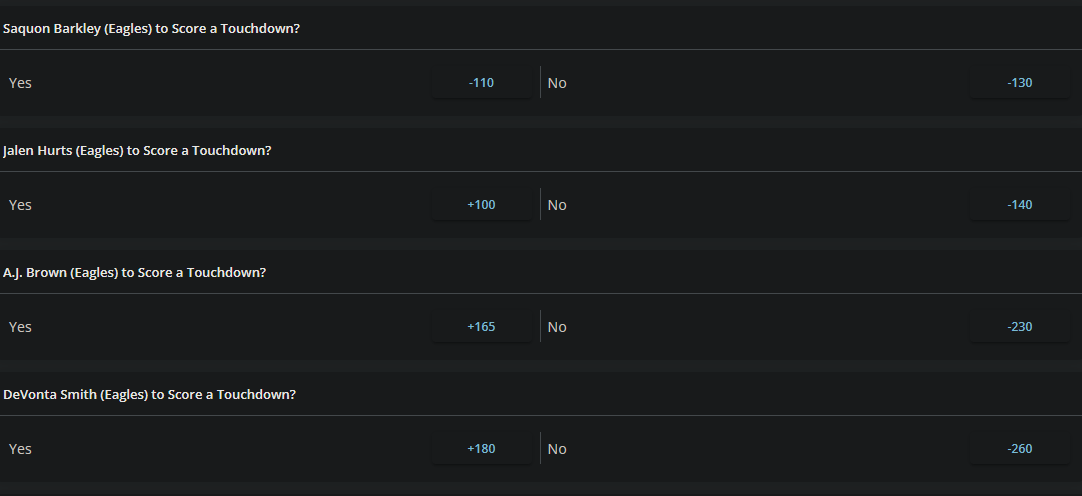
We can convert the lines to win probabilities and add them up to calculate the overround, as covered a couple of articles ago.
For the Saquon Barkley bet, the overround is 8.9%. For Hurts it's 8.3%, for Brown it's 7.4%, and 7.9% for Smith.
The overround for a normal spread bet is 4.5%. We saw it's about the same with NBA money lines. Because this book is reduced juice, overrounds on spread bets are around 2.6% -- for instance odds of -108/-102 or -105/-105 instead of -110/-110.
Prop bets have 2x the juice of a traditional spread bet, and over 3x reduced juice. That requires the gambler to win far more often just to break even.
Ways to potentially reduce bias
I've previously written about an experiment that showed gamblers tend to take the favorite, even when they've been told it's a worse bet than the underdog. That wasn't true of the Ringer teams last week. They only took 11 favorites out of 25, so they didn't show that particular bias. But I think the experiment gives a hint how to reduce bias in general.
The researchers found that people could be corrected of their bias towards favorites by writing out what they thought the lines should be before seeing what the lines were. It causes the person to actually try and do the math problem of whether the bet is a good investment or not, rather than anchoring on the price set by the market, and picking the better team, or the conventional wisdom.
It would be interesting to try having each team member decide what the fair line was, then average them out. Do predictions made that way perform better?
Similarly, it would be helpful to convert any odds from the American style (like +310, or -160) to the equivalent probability. People who have gambled a lot might have an intuitive sense of what -160 means, but for me, the equivalent 61.5%, or "about 5/8" is much clearer. I can imagine a large pizza missing 3 of the 8 slices.
Betting jargon and betting superstitions should be avoided. Does each bet make sense as a financial transaction? Personal feelings and the enjoyability of the bet shouldn't factor in. The quality of the game and who is playing in it shouldn't matter.
The bottom bun
Despite not being a gambler, the gambling podcasts I listened to were fairly enjoyable. It's basically Buddies Talk About Sports, which is a pleasant enough thing to have on in the background. Nobody would listen to Casey's Rational Betting Show, for multiple reasons.
The Mathletix Bajillion, week 2
The Ringer crew had a good week, collectively going 14-11 (56%). One team out of five is now in the green. mathletix still won the week, winning 60% of our bets.
As a reminder, one set of picks is generated algorithmically, the other randomly. I'll reveal which one at the end of the competition.
"line shopping" refers to how much money was saved, or extra money was gained, by taking the best odds available instead of betting at a retail sportsbook.
All lines as of Friday morning.
The Neil McAul-Stars
last week: 5-0, +504
line shopping: +4
- LAC -3 +100 (prophetX)
- TB +5.5 +100 (lowvig)
- MIN -3 +105 (lowvig)
- ARI +3 -101 (prophetX)
- SEA +3.5 -111 (prophetX)
The Vincent Hand-eggs
last week: 1-4, -334
line shopping: +6
- LAR -3 -110 (hard rock)
- SF -3 -101 (prophetX)
- DET +2.5 +100 (lowvig)
- TEN +6 -107 (prophetX)
- GB -7 -105 (prophetX)
